Address
Lahore, Pakistan
Work Hours
Monday to Friday: 7AM - 7PM
Weekend: 10AM - 5PM
Address
Lahore, Pakistan
Work Hours
Monday to Friday: 7AM - 7PM
Weekend: 10AM - 5PM


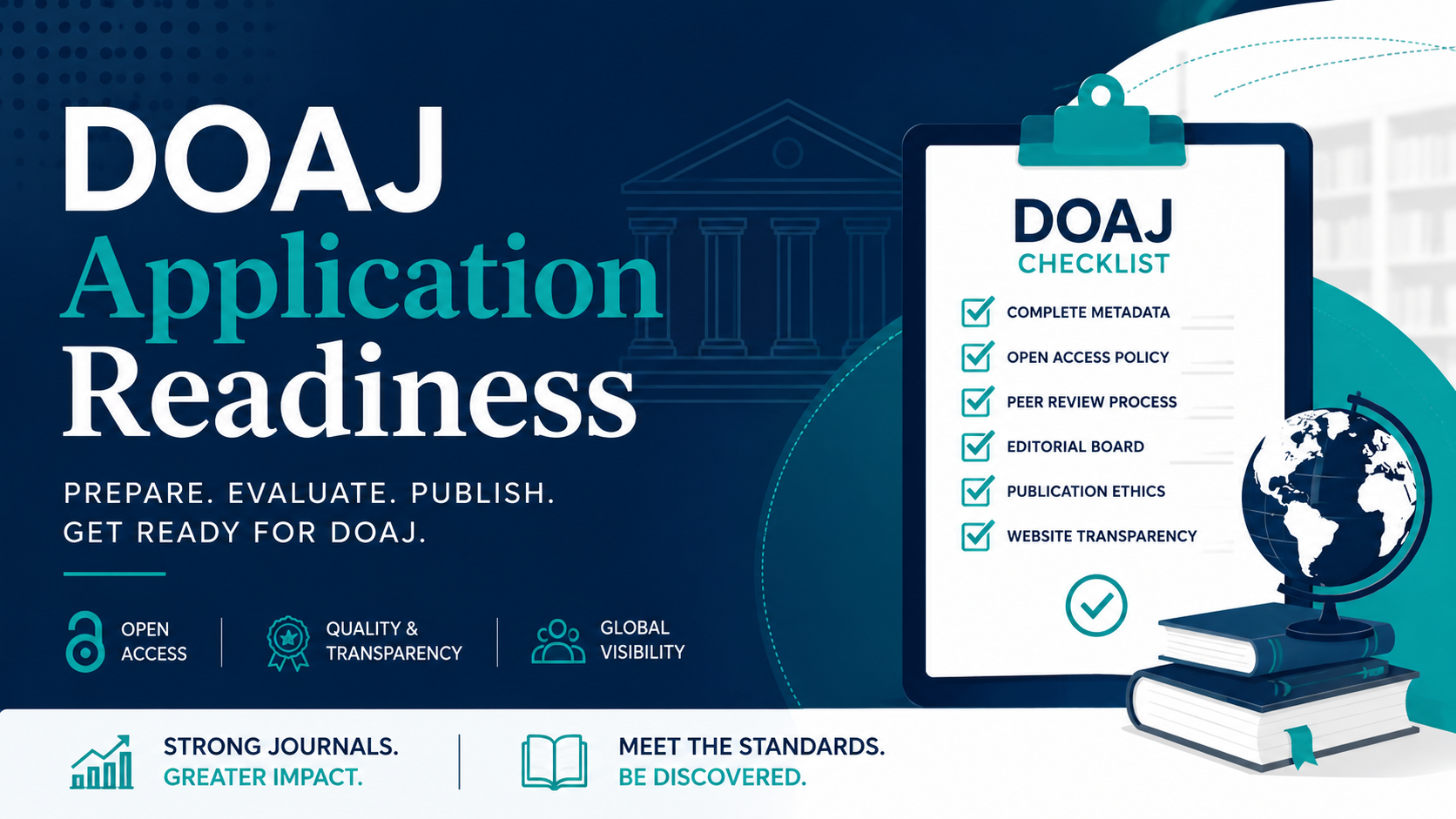
Getting a journal indexed in the Directory of Open Access Journals (DOAJ) is an important step for any academic publisher. However, before submitting an application, journal managers need to make sure that their website, publication policies, licensing information, and published articles are properly prepared.
I am sharing this article based on my own experience of submitting a journal application to DOAJ and getting it approved. During this process, I learned that preparing a journal for DOAJ is not just about completing an application form. The journal website itself needs careful attention, and even small inconsistencies between policies, article pages, PDFs, and application details can create problems.
If you are planning to apply for DOAJ indexing, I recommend reviewing the following points before submitting your application.
The first thing I recommend checking is the journal’s peer review system. If your journal follows double-blind peer review, clearly explain the process on your website.
Your peer review policy should describe how manuscripts are evaluated, how reviewers are selected, how editorial decisions are made, and how confidentiality is maintained. Authors should also be able to understand the review process before submitting their manuscripts.
Do not simply write “peer-reviewed journal” and leave it there. Provide a proper peer review policy explaining the actual process followed by your editorial team.
Make sure the journal follows the process described in its policy. A policy published on the website should reflect real editorial practice.
DOAJ is a directory for open access journals, so this is one of the most important points to review.
Readers should be able to access the full text of your scholarly articles without paying a subscription fee or registering an account. Your journal should not keep research articles behind a paywall or apply an embargo that prevents immediate open access.
I recommend publishing a dedicated Open Access Policy page on your journal website. It should explain that readers can access the published research freely and describe the rights available under the journal’s open licence.
Do not assume that your journal qualifies as open access simply because its articles are available to read for free. The licensing and reuse conditions also need to support the journal’s open access statement.
You can review the official DOAJ Guide to Applying for the current requirements.
Your journal must have at least one registered and confirmed ISSN before applying to DOAJ.
Depending on your publication arrangements, you may have:
Make sure the journal title shown on your website and application matches the title registered with the ISSN authority.
Display the relevant ISSN clearly on your journal website. I recommend checking the details through the International ISSN Portal before submitting the application.
One of the most important lessons I learned is that journal policies should not be treated as optional website content. They help reviewers understand how your journal operates and whether its publishing practices are transparent.
Before applying, check that the following policies are available and easy to find:
You should also provide your aims and scope, editorial board with affiliations, publication frequency, publisher information, and a reliable contact email.
Avoid placing all this information on a single crowded page. Organise your journal website so authors, readers, and reviewers can find the relevant information easily.
Digital preservation is another important part of preparing a journal website.
Your archiving policy should explain how the journal intends to preserve published articles and maintain access to its content over the long term. Do not simply list preservation services without checking whether your journal actually participates in them.
For reference, here are some relevant services and resources:
If you use OJS, check whether the PKP Preservation Network is available and properly configured for your journal.
Important: Mention only the preservation services your journal actually uses or is eligible for. Adding a service’s name or logo to your website does not prove that your journal’s content is being preserved there.
You can also consult the DOAJ Guide to Applying for its recommendations on archiving and digital preservation.
Along with your other policies, publish a dedicated Open Access Statement on your journal website.
The statement should explain that the full text of published scholarly articles is immediately available without subscription or registration barriers. It should also explain the reuse rights provided by the journal’s licence.
Keep the wording consistent across your open access policy, licensing policy, article landing pages, and published PDFs.
If your journal claims to provide open access but another page states that users cannot reuse the content, you may have a contradiction that needs to be resolved before applying.
Licensing is one area I strongly recommend checking before submitting a DOAJ application.
For many open access journals, I recommend the Creative Commons Attribution 4.0 International (CC BY 4.0) licence. It allows others to share and adapt the licensed material, including for commercial purposes, provided they give appropriate credit and comply with the licence terms.
Official licence link: Creative Commons Attribution 4.0 International.
However, choosing a licence is not enough. You must make sure the licence is applied and displayed consistently.
Before applying, check the following:
For example, if your journal uses CC BY 4.0, make sure the article pages and PDFs do not display a different Creative Commons licence.
If you have already published many articles, do not check just the latest issue. Review the older articles as well.
My recommendation: Before submitting your application, open every published article page and inspect the licence. If the article has a PDF or another galley, check that too. Consistency throughout the journal is important.
You can read the official DOAJ Licensing and Copyright Guidance for further details.
Copyright and licensing are related, but they are not the same thing.
Your copyright policy should clearly explain who retains copyright in published articles and what rights the author grants to the publisher.
I recommend a transparent arrangement in which authors retain copyright and grant the journal the necessary rights to publish their work. This approach can support author rights while allowing the publisher to distribute the research under an open licence.
If your journal follows this model, explain it clearly in the copyright policy and make sure it agrees with the licence displayed on published articles.
Avoid contradictory statements. For example, do not say that authors retain their rights while another policy requires them to transfer all copyright to the publisher.
The exact wording should reflect the arrangement your journal actually uses.
A Digital Object Identifier (DOI) helps readers identify and locate published research through a persistent link.
I recommend assigning DOIs to your journal articles and checking that they resolve correctly before applying. If you use Crossref, ensure that the DOI metadata has been deposited accurately and that the DOI links lead to the appropriate article pages.
Check the following:
Persistent article identifiers are recommended by DOAJ as a good practice for improving the discoverability and reliability of published research.
A DOI alone does not guarantee acceptance, but accurate article identification and metadata are valuable parts of good journal management.
Every journal should explain how it handles plagiarism and other forms of publication misconduct.
Your plagiarism policy should describe how submitted manuscripts are checked, how suspected plagiarism is investigated, and what action may be taken if misconduct is identified.
If your journal uses a similarity-checking service, you can mention the service and explain how the results are assessed by the editorial team.
Avoid relying only on a similarity percentage. Similarity reports need to be reviewed in context because legitimate quotations, references, and common phrases can affect the results.
Most importantly, make sure your stated policy reflects the actual process followed by your editors.
DOAJ highly recommends the use of plagiarism-checking services, although the service itself is not a mandatory inclusion requirement under its current application guide.
If your journal charges an Article Processing Charge (APC), publication fee, submission fee, or any other author charge, publish the details clearly on the website.
Your APC policy should explain:
If your journal does not charge any fees, state that clearly as well.
One mistake I recommend avoiding is entering one APC amount in the application form while displaying a different amount on the website. Check that the information matches everywhere.
For example, if your website states that the APC is USD 100, do not enter USD 120 in the application unless the actual policy has been updated and the correct information is reflected consistently.
Be transparent about fees. Authors should not have to contact the editorial office just to discover the basic publication charges.
Author Guidelines are essential for a journal’s professional presentation and editorial workflow.
Your guidelines should explain the manuscript submission process, formatting requirements, reference style, authorship expectations, ethical declarations, and any other requirements relevant to your journal.
You can also include instructions about figures, tables, supplementary materials, research ethics approval, conflicts of interest, and data availability where applicable.
The most important thing is that your guidelines should be easy to locate and understandable to prospective authors.
If your journal uses OJS, add a clear link to the guidelines in the navigation menu so visitors do not have to search through several pages to find them.
Do not assume that a licensing policy automatically covers every aspect of copyright.
Your copyright policy should explain who owns the published work and what rights are granted to the journal. It should be consistent with the open access policy and the licence applied to articles.
For an open access journal, avoid displaying “All Rights Reserved” in a way that contradicts the open licence under which the article is published.
If you recommend that authors retain copyright, ensure that the author agreement, copyright policy, article pages, and PDFs follow that arrangement.
This is another area where reviewing actual published content is just as important as reviewing the policy page.
I also recommend reviewing the indexing and abstracting services displayed on your journal website before applying.
Some journals display a long list of directories, search engines, or questionable indexing services to make the website appear more impressive. This is not necessarily helpful.
DOAJ’s guidance states that journals should avoid being listed in unreliable indexes and must not display references to certain unrecognised impact factors or ranking metrics.
My advice is to verify every service before adding its name or logo. Make sure the journal is genuinely listed, the listing is current, and the service is credible.
Do not claim indexing in Scopus, Web of Science, or another recognised database unless you can verify the journal’s actual inclusion.
There is no guarantee that removing a particular low-quality listing will secure DOAJ acceptance. However, presenting accurate indexing information and avoiding questionable claims are sensible steps toward maintaining a professional journal website.
This is one of the most practical recommendations I can share from my experience.
Even if your policy pages look perfect, problems can remain in individual articles. A journal may have the correct licensing policy but an older PDF may display a different licence. An article page may show a DOI that does not match the PDF, or the copyright statement may be missing from some published content.
Before submitting your DOAJ application, review your journal issue by issue and article by article.
For each article, check:
If your journal has several years of published content, this task may take time. Nevertheless, it is worth doing before applying rather than discovering inconsistencies during the review.
When the website is ready, review the DOAJ application form carefully.
The information in the application should match the information available on the journal website. Pay particular attention to the journal title, ISSN, publisher details, open access arrangements, peer review process, copyright, licensing, APC, and publication frequency.
Do not rush through the form or provide answers based on what you plan to implement later. The application should describe the journal as it actually operates at the time of submission.
I recommend keeping a final checklist and reviewing every answer before submitting.
You should also monitor the email address used in the application and check your spam folder. If the DOAJ team contacts you for clarification, respond promptly. Failure to respond to questions within the specified period can lead to rejection.
Based on the official DOAJ guidance, the time from submission to a decision varies, but a decision is generally reached within six months. The actual waiting period can depend on the review process and how promptly the applicant responds to questions.
If your application has been pending for six months without an update, you can contact DOAJ to ask about its status. DOAJ states that it cannot provide status updates for applications that are less than six months old.
Official reference: DOAJ Guide to Applying — Application Process and Review Time.
During the waiting period, continue maintaining your journal website, publishing according to your stated schedule, and keeping your policies and article information accurate.
Do not assume that a long review period automatically means your application has a problem.
From my experience of submitting a DOAJ application and getting it approved, my main advice is to prepare the journal website properly before submitting the form.
Check the peer review process, open access statement, ISSN, archiving policy, licensing, copyright, author rights, DOI information, plagiarism policy, APC, and author guidelines. Most importantly, review every published article and galley to make sure the information is consistent.
DOAJ indexing is not simply about adding policy pages to a website. The journal needs to demonstrate transparent publishing practices, reliable editorial procedures, and accurate information about the research it publishes.
Take the time to review the details carefully. A well-maintained journal website makes the application process more organised and helps build trust with authors, readers, and the wider academic community.
My final recommendation: Before clicking the submit button, review your journal as if you were the person evaluating the application. If the policies are clear, the published articles are consistent, and the information in the application matches the website, you will be in a much better position to submit a complete and accurate application.
Note: DOAJ’s criteria and guidance can change. Always consult the official DOAJ application guide before submitting your application.
